FL Early Voting Final Numbers (almost), with graphs

It looks like the Winter Park early voting site in Orange County is voting today (bomb scare yesterday), so the Florida early voting number aren’t 100% in, but it’s close, so here goes.

The basic spreadsheet is here, with party breakdowns by day.

First, the total early voting turnout was nearly 2.4m, compared to over 2.6m in 2008, for a reduction of 9.3%.

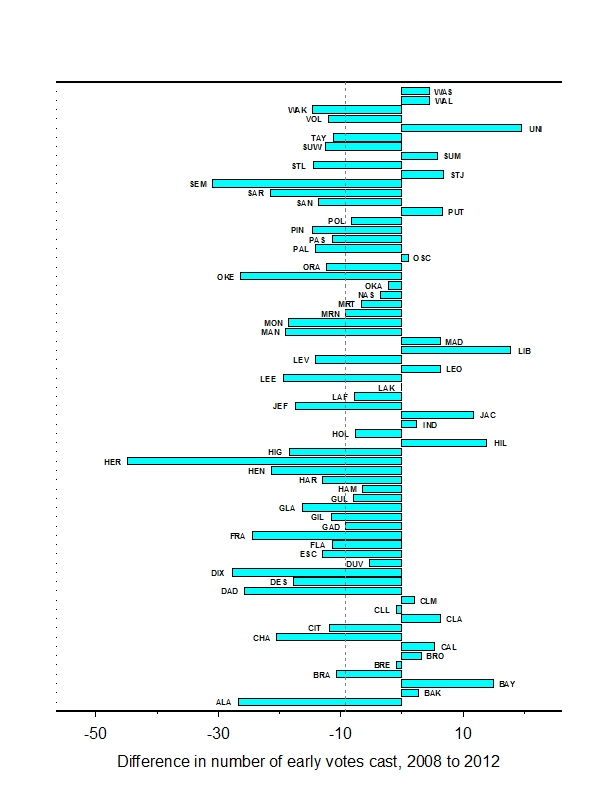
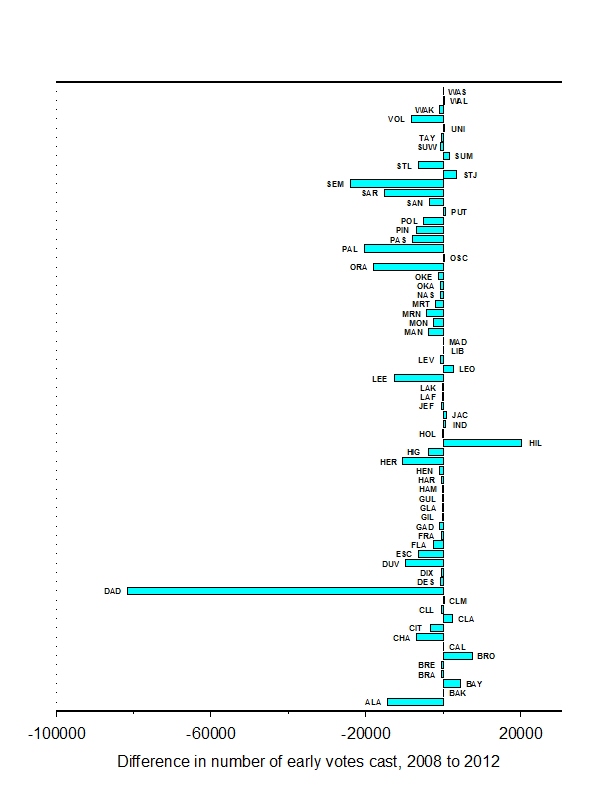
Second, the reduction wasn’t uniform as the following three graphs show.  Graph 1 plots (on a log scale) the number of early votes cast in 2012 (vertical axis) against early votes cast in 2008 (horizontal axis).  Graph 2 is a bar chart that shows how many more early votes were cast in each county, compared to 2008; Graph 3 shows this in percentage difference terms.  (On this graph, the average 9.25% reduction is shown by the dashed line.)

The change from 2008 to 2012 isn’t simply a matter of the smaller counties showing greater variability.  In fact, there is zero correlation (r = -.06) between the (logged) number of early votes cast in a county and the absolute value of the percentage difference between 2008 and 2012.  I’m sure analysis will be forthcoming to explain these differences.

Graph1:  Early voting compared, 2008 to 2012 (click on graph for a bigger view)

Graph 2:  Bar chart showing difference from 2008: (click on graph for bigger view)

Graph 3.  Bar chart showing percentage differences: (click on graph for bigger view)


FL Early Voting through Friday

I was just able to process the early voting files from Florida through Friday.  Thursday and Friday end up being record days for early voting turnout:  300,000 Thursday and 343,000 Friday.  It’s now passed the 2m mark.  Last year, a total of 2.6m voted early, so it’s unlikely they will match last year’s numbers.  However, it will probably be closer than I was speculating before.

The partisan division continues the same pattern as before, and will not change much with Saturday’s voting.  As of Friday, 46% of early voters were Democratic registrants, and 37% Republican registrants.  Last year it was 52%-31%, so there’s been a six percentage point shift toward the Republicans.

Click here to download the Excel file.

Smithsonian Political Machines Symposium

The Smithsonian National Museum of National History sponsored a symposium — Political Machines:  Innovations in Campaigns and Elections today.

This morning started with a keynote talk by Darrell West of the Brookings Institution.  He gave an interesting talk on how politics is being changed by technology.  He noted how campaigns and political groups are using consumer and political data are being combined to allow for micro-targeting and nano-targeting of political messages.  There was a fascinating question asked to Professor West, which was that, in the future, campaigns and groups may know your cell number and perhaps can know your GPS location so that, as you approach the poll or even when you are right inside the room, campaigns will be sending you texts and emails encouraging you to vote for or against a specific candidate or issue.

The second panel focused on campaigns.  Jon Grinspan, a doctoral candidate in the Corcoran Department of History at the University of Virginia, talked about the craziness of campaigns in the 1800s.  He noted that, back then, the undecided voter was derided; people were members of political teams and the teams competed to win, having large rallies, marches, and intimidating voters at the polls by challenging people thought to be of the other party.  Zephyr Teachout talked about the 21st century election work, noting how the internet works in politics and how its use also is threatening to the traditional campaign, because it allows voters who support a candidate to act independently, without guidance from the campaign.

I am speaking this afternoon and will post more later.

Voter registration up in California

There are more details in this story from the LA Times, “Number of California voters reaches record levels.” Readers of our blog will likely be interested in how the new online registration system in California has influenced this:

More than 1.4 million new voters have signed up, nearly 50% of them online under a new law that kicked in six weeks ago allowing electronic registration. They tend to be younger and more left-leaning than the state’s general voting population, according to Political Data Inc., a bipartisan firm that analyzed county reports.

Some analysis about Florida early voting trends

I’ve ginned up a couple of graphs to compare early voting trends in Florida between 2008 and 2012.  If you don’t want to delve into the full narrative, here is the take-away:  early voting is down in Florida statewide, but somewhat more-so in counties that gave Obama the biggest majorities in 2008 (and continue to do so in 2012).

The first thing to note is that turnout is down via early voting, if we compare 2008 and 2012 at the point where there were three days left to vote early.  The raw numbers are 1,364,574, with three days left to vote in 2012, compared to 1,995,399 in 2008.  So, overall, early voting is down by 31.6% compared to 2008.


Second, the decline isn’t uniform across the state.  The accompanying scatterplot shows the turnout numbers for each county, with 2012 on the y-axis and 2008 on the x-axis. (As with most of the graphs in this post, you can click on it to get a better version.)  The data tokens, with abbreviations for the counties, show comparable early voting turnout the two years.  The heavy red line shows turnout equality with 2008.  The lighter green line shows what turnout would be, if the drop from 2008 to 2012 was proportionally equal across all counties.  Obviously, it’s not.  The largest county in the state, Miami-Dade, is sagging more than the statewide average.
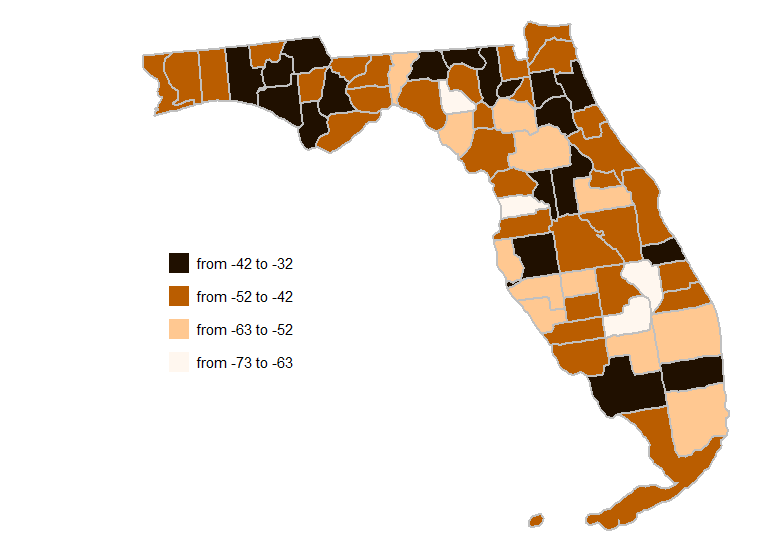


The accompanying map shows where turnout has declined, in percentage terms. I admit it’s a bit of a bear to read, but keep this in mind: the lighter the county, the more turnout has declined. In this map, it is clear that turnout is down the most in two areas Obama was counting on significantly: Miami-Dade and Palm Beach, in the southeast, and Orange County, in the center of the state. While Hillsborough and Broward Counties — strong Obama territory are among the counties with the least decline — the map is darkest in the panhandle, which is prime Romney Country.


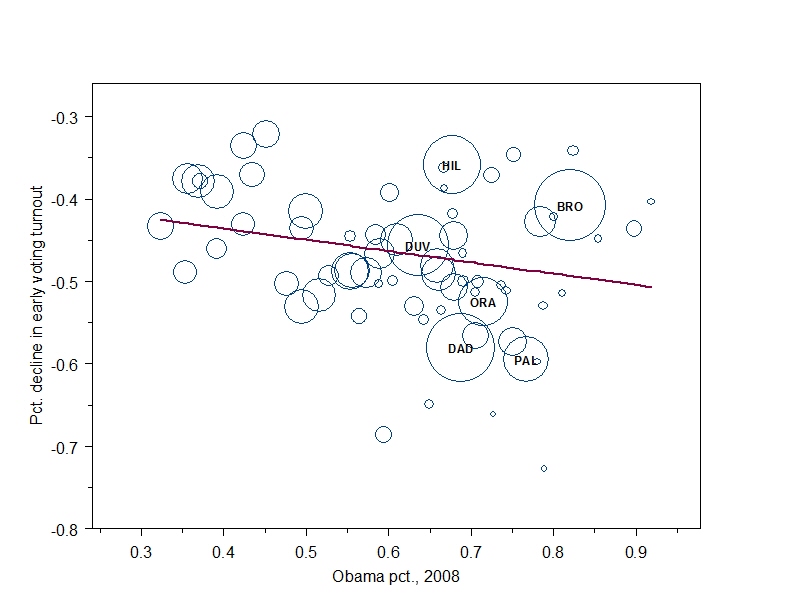
These two graphics raise the question of whether the decline in early voting turnout has, in fact, been strongest in the parts of the state that supported Obama the most in 2008. This question is easily answered with this graph, which plots the percentage decline in early voting turnout on the y-axis against the percent of the vote for Obama among early voters in 2008 on the x-axis.  The red line is the regression line through the data. The data tokens are in proportion to turnout (thus far) in 2012, with the six largest counties noted explicitly.  There is a weak relationship here, but statistically significant at the traditional levels. (The equation of the line is – 0.38 – 0.14x, with standard errors of 0.04 and 0.07, respectively.  R-sq = .06)
None of this analysis says why these relationships hold, nor why the decline has happened in the first place.  It is very clear from the emerging statistics that people who used early voting in 2008 have not just shifted their early voting behavior to the time period they now have available to them.  Reducing the number of days for early voting has clearly reduced the number of early voters.  Whether these folks will end up voting elsewhere remains to be seen after the election.  Whether the relatively greater decline of early voting in the strongest Obama counties is due to a strategic decision on the part of campaigns is another question, too, we will only know the answer to after the election.

Florida update for early voting

Teaching got in the way of posting an update of early voting statistics from Florida, as of the COB yesterday.

I’ve posted the updated spreadsheet here. (Dropbox has apparently been experiencing some Sandy-related outages, so let me know if you can’t make this link work.)

Same trend as before.  For the first time this year, the number of new early votes is below then number at this point in the countdown to the election in 2008.  At this rate, there will be between 400k and 500k fewer in-person early votes in Florida than in 2008.  Also, the D-R margin at this point is much less than in 2008:  10.5 percentage points, compared to 21.3 percentage points.

Profile of Peter Neumann

I don’t always agree with his concerns over electronic voting, but there is no doubt that Peter Neumann is a major personality in the history of computers in the U.S., and a generous soul. I found the profile of him in today’s NYTimes fascinating.  Please read it, if you haven’t.