Ballot translation error in Arcadia, CA

Paul recently wrote about a balloting problem in Illinois.

Here’s a different one, out here in Southern California. Arcadia is a city just east of Pasadena, with a large Asian-American population. The problem regards an incorrect translation of the ballot, and this story contains much of the details, “Arcadia Election Ballots Contain Translation Blunder.” Here’s an updated version of the story, as the election officials in Arcadia are trying to figure out how they are going to pay to resolve the problem.

Bernd Beber and Alexandra Scacco, “What the Numbers Say: A Digit-Based Test for Election Fraud”

Political Analysis, the journal that I co-edit with Jonathan Katz, just electronically published in Advance Access a new paper on the statistical detection of election fraud.  This paper, by Bernd Beber and Alexandra Scacco, is titled “What the Numbers Say:  A Digit-Based Test for Election Fraud.”  Here is the paper’s abstract:

Is it possible to detect manipulation by looking only at electoral returns? Drawing on work in psychology, we exploit individuals’ biases in generating numbers to highlight suspicious digit patterns in reported vote counts. First, we show that fair election procedures produce returns where last digits occur with equal frequency, but laboratory experiments indicate that individuals tend to favor some numerals over others, even when subjects have incentives to properly randomize. Second, individuals underestimate the likelihood of digit repetition in sequences of random integers, so we should observe relatively few instances of repeated numbers in manipulated vote tallies. Third, laboratory experiments demonstrate a preference for pairs of adjacent digits, which suggests that such pairs should be abundant on fraudulent return sheets. Fourth, subjects avoid pairs of distant numerals, so those should appear with lower frequency on tainted returns. We test for deviations in digit patterns using data from Sweden’s 2002 parliamentary elections, Senegal’s 2000 and 2007 presidential elections, and previously unavailable results from Nigeria’s 2003 presidential election. In line with observers’ expectations, we find substantial evidence that manipulation occurred in Nigeria as well as in Senegal in 2007.

Elections, Representation, and Accountability

Doug Chapin says I am just an old crotchety guy.   I’m old and I’m crotchety, but I don’t think I’m being unfair. I just get worried when something is oversold.

Here’s what TurboVote promises:

If voting were easier, more people would do it. And if more people voted, we could reinvigorate local and primary elections, politicians would be held more accountable, our leadership would be more representative, and our democracy would work better.

Making voting easier helps, but it’s only one link in the chain of accountability.  Przeworski, Stokes, and Manin write in the introduction to Democracy, Accountability, and Representation, when describing the difficulty in disentangling competing notions of representation, accountability, and democracy:

Yet, there are some things we have learned.  Perhaps foremost is the importance of information.  The main difficulty in instructing governments in what to do and in judging what they have done is that we, citizens, just do not know enough.

Vastly increasing votes without simultaneously improving the quality of the vote could easily do more damage than good, particularly in an age where we can be micro-targeted down to our underwear size.

I am not trying to be crotchety; I hope I am instead constructively critical.  My worry is buyer’s regret. Transforming the American political system will take place in decades, not in months.  Once we make voting easier, it’s time to make politics easier.  Then we may witness a true sea change.

P.S. The link above lists a great sounding job for someone interested in election data (although there are 3810 counties, not election jurisdictions. The latter number exceeds 10,000 when you take into account townships and municipalities).


The Internet Isn’t All About Awesomeness

Doug Chapin pointed me to this event at SXSW: http://schedule.sxsw.com/2012/events/event_IAP10299.  I’m sure my fellow commentators can chime in here, and they are not all dinosaurs like me and Charles (by the way my friend, your MIT page is way more awesome than your personal page!).

The event, featuring two of the founders of TurboVote,  asks “Why hasn’t the Internet made voting awesome?”

Any one of us could give a long lecture on this, not least Michael and Thad who still show some old scars from previous attempts to implement Internet voting among military members (Google “SERVE military voting”).  The panel description unintentionally mentions some of the ways that the Internet is not completely awesome.

Sure, you can “download any song you want,” and millions do it illegally.

You can “get shoes delivered the next day” but as long as Internet giants like Amazon successfully lobby to refuse to pay local sales taxes, they undermine local governments and compete unfairly against local businesses.

The Internet works well in some arenas and not as well in others.  In politics, it have revolutionized some areas, such as information gathering and campaign finance (though it is not clear that the impact on the latter has been all good).

But I suspect that most political scientists start these conversations the same way: the main barrier to participation in the United States is not technological, its attitudinal.  As long as most Americans don’t find politics and elections central to their daily lives, then even the simplest, most innovative, most socially networked elections system will not result in that much of a boost in participation.

Just look at the other nations to which we compare unfavorably: newly emerging democracies like Cambodia (turnout has averaged over 80% since 1993) or established democracies like Germany (turnout ranges from 70-85%)?  It’s not the Internet that distinguishes us from these nations.  It’s something else.They have far fewer elections (less voter fatigue); they have a centralized and highly decentralized elections system (far less variation in rules and procedures); they have election formulas which translate votes into seats with much higher fidelity.

Don’t get me wrong–I’m thrilled to see new entrepreneurs enter the elections field and try to modernize and transform the way our elections are conducted.  I am not a Luddite.  Technology can improve many parts of our system.  Some might suggest that the desire to make voting “fit the way we live today” is precisely the problem–citizenship is about obligations as well as convenience.

And I’d like to see some of these folks wrestle with the fact that technology isn’t the cure to everything.  Two decades of research by Don Green and his colleagues has shown that good old shoe leather politics–combined with sophisticated targeting–is what really makes a difference in turnout

I’d like to see some of these folks dedicate some of their brilliance–and resources–to some of the more fundamental barriers in our system: historically high levels of inequality, geographically based districts, a highly disproportional election formula, a broken campaign finance system, and the two party duopoly.

Poll taxes in California

Those of you in Southern California know how interesting and fun the monthly Rose Bowl Flea Market can be:  collectibles, antiques, and people-watching.

This morning I went with my daughter, and picked up an unusual find (at least unusual to me, as this is something I had never seen before):  a collection of poll tax receipts, from 1901-1909, from San Diego California, CA.  Two of them are reproduced below.

I’ve not researched their history, nor the history of poll taxes in California.  If any readers have tips on where to find out more about this aspect of California’s election administration history, please get in touch.

OSCE/ODIHR releases Election Expert Team Report on Internet Voting Pilot Project in Norway

Last week, OSCE/ODIHR released its election expert team report on the Internet Voting Pilot Project in Norway.

Norway’s internet voting project for the 12 September 2011 local government elections was conducted in an open manner, but the system could have benefited from more formalized procedures, concludes the final report of the OSCE Office for Democratic Institutions and Human Rights’ Election Expert Team. The report was released on 2 March 2012.

According to the report, Norway’s Ministry of Local Government and Regional Development, which implemented the project, performed its duties impartially and professionally. Despite certain technical difficulties and minor delays, the report says, the Ministry ensured a high level of security of the internet voting system, which was used as an additional voting channel for voters registered in ten selected municipalities.

Internet voters received a specially designed secret code, for checking whether their votes were cast as intended. However, the report highlights, due to the complexity of this feature’s design, the authorities experienced certain technical problems.

In addition, many aspects of the pilot project were not formalized, including the set-up, operation, security, testing and data disposal procedures, as well as defining the grounds for invalidating electronic votes. The report adds that the pilot could have also benefited from more comprehensive testing.

Election Day vs. Early Votes in the Ohio Presidential Primary

Rob Richie and I have been arguing for the use of ranked choice ballots for overseas voters, and potentially all absentee voters, in the presidential primary process.  Our concern is that candidates who have withdrawn from the race remain on those absentee ballots, and overseas voters in particular have to mail their ballots back without realizing that some candidates have withdrawn.

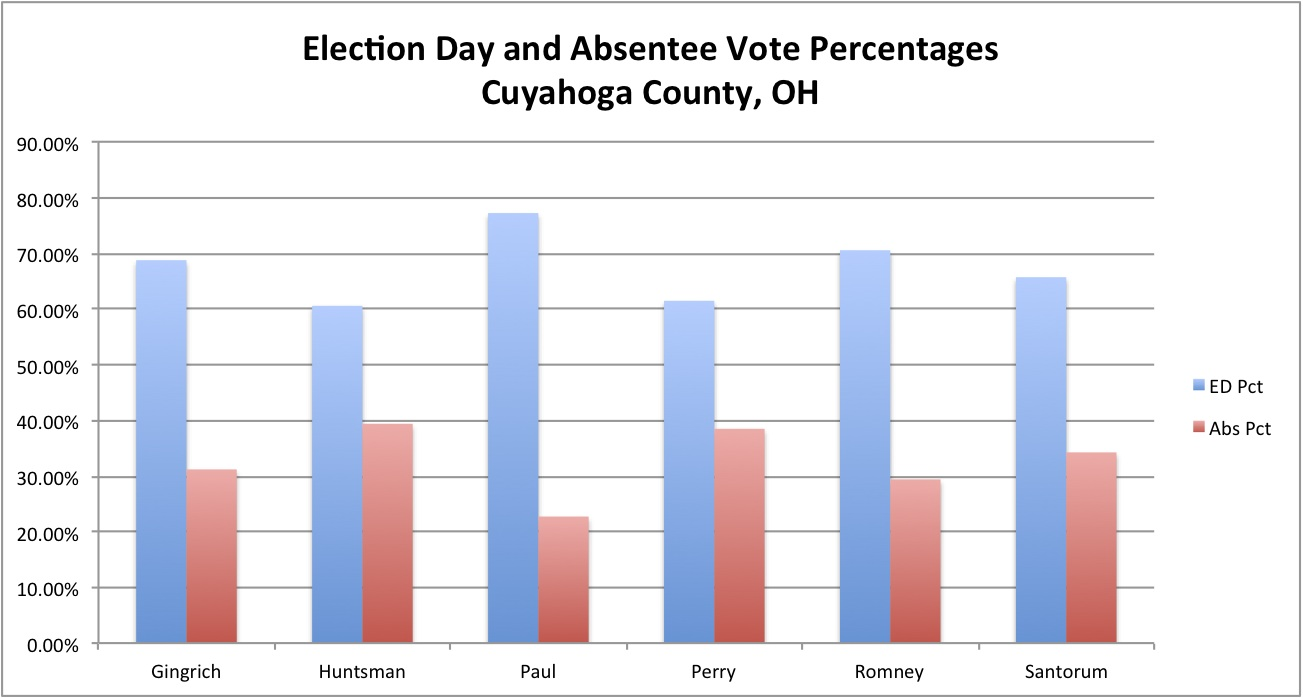
The recent Ohio primary provides only mixed support.  While we don’t have information on when the absentee ballot were returned, it does appear that Perry and Huntsman received a larger percentage of their votes on absentee ballots.  Still, there are obviously a lot of election day voters who cast a ballot for one of these two candidates.

It might be interesting to observe “non running” candidates as a measure of voter dissatisfaction with the current crop of candidates.  Nice dissertation topic?  I’ve never seen anyone do this analysis before.