Would ranked choice absentee ballots have allowed Santorum to win the Ohio primary? The gap between Romney and Santorum was less than 8000 votes, and Perry and Huntsman combined received 13,000 votes. It’s a very interesting intellectual exercise to wonder how many of those ballots were cast absentee, and how many of those voters would have chosen Santorum (Perry voter?) and Romney (Huntsman voters?) as their second choice.
Daniel Smith (aka ElectionSmith) on Early Voting in the Florida Primary
See this recent posting by Dan Smith on early voting in Florida:
Updates on everything early voting
Apologies to our regular readers for my absence for a few weeks. I’m back to update you on all things early voting.
Some of you may have seen an editorial in Roll Call that Rob Richie and I authored, arguing for ranked choice voting in presidential primaries for overseas absentee ballots. If anyone has reactions, I’d love to hear them. I think this is a great idea, and I’m pondering whether I should work with Rich to push this more systematically in a few states for 2016.
Voting reform is pushing ahead in Connecticut. It looks like online voting registration–an initiative of the Pew Center on the States--will be put in place. The legislature may also relax no-excuse absentee voting requirements. This means my standing comment in powerpoint presentations about the Northeast may need to be amended!
Early voting rates in Ohio seem to be lagging behind 2008. Some local officials speculate that it may because of a fear that candidates will drop out, but I don’t find that particularly convincing. None of the leading four candidates is showing any signs of withdrawing at this point. As Mike Alvarez has argued in his book, it is probably because voters remain uncertain and candidate support is fluid in the Buckeye State.
Another Ohio controversy is brewing over changes to the period for early voting.
Weekend reading for election geeks, “How to Win an Election”
“Civitas quae sit cogita, quid petas, qui sis.”
What great advice for an aspiring politician, which translates to “Always remember what city this is, what office it is you seek, and who you are.”
This is the second paragraph from a fun new book recently published by Princeton University Press, How To Win an Election: An Ancient Guide for Modern Politicians, by Quintus Tullius Cicero and translated by Philip Freeman. It’s sort of a Roman The Prince, though written not from the perspective of how to rule, but about how to run an election campaign in ancient Rome. The book features the original Latin, with the English translation on the facing pages. So election geeks get the best of both worlds, both Latin and English!
Thanks to Princeton Press editor Chuck Myers for sending this along to me; PUP has published a lot of interesting books recently, including Thad and my Electronic Elections. However, as far as I know there are no plans to translate our book into Latin, at least not yet.
Guest Blog: Martha Kropf, “Ballots and Voter Errors”
Policymakers and political scientists alike should pay attention to Herrnson, Hanmer and Niemi’s forthcoming article, as tagged by Mike Alvarez. The advantage of this study is that they have analyzed the individual’s interaction with the ballot via the experimental research design similar to that marshalled in their book Voting Equipment: The Not-So-Simple Act of Casting a Ballot (Brookings, 2008).
In short, they find that voters cast fewer unintentional undervotes in partisan races using a straight party option. Yet, in non-partisan race, voters make as many or more “errors of omission”. Particularly affected? Less educated and elderly voters.
Herrnson, Hanmer and Niemi’s article makes an important point: “… the ballot is the means through which voters register their intentions, and it is the dominant feature voters observe once they begin the voting process. Symbolically, it is more meaningful. As Beard pointed out a century ago: “The point of contact between the average voter and his government is the ballot . . . ” (1909, 590).
This work pairs nicely with presently-existing work, such as my recently published book with David C. Kimball, Helping America Vote: The Limits of Election Reform (Routledge, 2012). Using nationwide, aggregated data, we are able to show that residual votes are higher on ballot measures (non-partisan races) in states with the straight-party ticket. The straight party feature tends to reduce the probability of residual votes on partisan contests. However, the straight party feature is one of the more politically contentious ballot features! Often ignored by policymakers are features such as a connect-the-arrow on an optical scan ballot, which we show is responsible for a variety of ballot errors, especially overvotes (see Chapter 5 entitled, “We Mostly Eliminated the Butterfly Ballot: Isn’t That Enough?”). Overall, we provide empirical evidence that graphic design and usability research can guide us to make great improvements in ballot design.
One theme of Helping America Vote is that our country focused rather narrowly on voting equipment itself and its security over the past 12 or so years. Somewhat ignored was ballot design and usability. Our book shows the consequences for election reform when we make incremental reforms that focus on relatively small parts of the whole process. Together, with Herrnson, Hanmer and Niemi, our research encourages scholars and policymakers alike to think the act of voting as occurring in a system. A more broad view of the system is likely to improve both access and integrity.
However, I would be amiss if I did not stress for blog readers how important I think the very publication in one of our field’s top journals is. Rather than being dismissed as “not really political science”, I think this publication symbolizes the recognition that usability theory (and other interdisciplinary theory as well) as notable and important effects upon political behavior. Furthermore, ballot design is one of the many institutions that affect political outcomes.
About the author: Martha Kropf is an Associate Professor in the Department of Political Science and Public Administration at UNC Charlotte. With David C. Kimball, she wrote a recently-published book, Helping America Vote: The Limits of Election Reform (Routledge).
New research on voting errors and ballots by Herrnson, Hanmer and Niemi
Paul Herrson, Michael Hamner and Richard Niemi have an interesting study that is available in Early View at the AJPS. The paper, “The Impact of Ballot Type on Voter Errors”, presents results from field studies the authors conducted, examining two different ballot formats.
Here’s the paper’s abstract:
Studies of ballots have traditionally focused on roll-off, candidate order, and partisan advantage. This study is among the first to assess the impact of ballots on individual-level voter errors. We develop new hypotheses by bringing together theoretical insights from usability research and political science about the effects of ballots with and without a straight-party voting option. By comparing voters’ intentions to the votes they cast, we are able to create two measures of voter errors: votes unintentionally cast for the wrong candidate and unintentional undervotes. Voters generally make fewer errors of both types when using a standard office-bloc ballot than when using an office-bloc ballot with a straight-party option, with the number of wrong-candidate errors substantially exceeding the number of unintentional undervotes. Voters’ background characteristics have a significant impact on their ability to vote without error. Our results offer a new perspective for evaluating the use of the straight-party option.
OSCE-ODIHR report on Swiss 2011 elections
Recently the OSCE-ODIHR election assessment mission report for the 2011 Swiss elections was released, including an analysis of the internet voting trials conducted by the Swiss in the fall 2011 elections. Here is a summary statement from the report:
The careful, limited, and step-by-step manner in which Switzerland is introducing and testing internet voting is a good practice, both to ensure the integrity of the systems used and build public confidence in the process. In general, the OSCE/ODIHR EAM found the internet voting trials to work reliably and enjoy wide public trust. Nevertheless, there appear to be some weaknesses in the systems, including both legal and technical issues.
Further in the report, there are recommendations that future evaluations of internet voting in Switzerland be done in a more open and transparent manner, in particular with relation to system testing and certification, and the public’s ability to observe the internet voting process; the report noted “…there did not appear to be a meaningful possibility for the general public to observe or oversee internet voting procedures. Most key documents and explanations were not readily available to the public. Although the Federal Chancellery reports regularly to the National Council on the progress of internet voting, the OSCE/ODIHR EAM was informed that there has been limited parliamentary interest and political parties have not made any serious study or review of the internet voting systems.”
It’s an interesting report to read, and one that anyone with interest in voting technology and especially internet voting should take a close look at.
New paper by Susan Hyde on electoral competition
Political Analysis has a new paper by Susan Hyde and Nikolay Marinov available in Advance Access, “Which Elections Can Be Lost.” Susan, who along with Thad and I edited “Election Fraud”, has here co-authored an interesting piece (and provided a really helpful data set of national elections from 1945 to 2006). Here’s the abstract:
The concept of electoral competition is relevant to a variety of research agendas in political science, yet the question of how to measure electoral competition has received little direct attention. We revisit the distinction proposed by Giovanni Sartori between competition as a structure or rule of the game and competitiveness as an outcome of that game and argue that to understand which elections can be lost (and therefore when parties and leaders are potentially threatened by electoral accountability), scholars may be better off considering the full range of elections where competition is allowed. We provide a data set of all national elections between 1945 and 2006 and a measure of whether each election event is structured such that the competition is possible. We outline the pitfalls of other measures used by scholars to define the potential for electoral competition and show that such methods can lead to biased or incomplete findings. The new global data on elections and the minimal conditions necessary for electoral competition are introduced, followed by an empirical illustration of the differences between the proposed measure of competition and existing methods used to infer the existence of competition.
A new one for my friend Thad: Early votes “determine” outcome
Thad Hall, my fellow blogger, regularly pillories this election-line lede: “Election outcome will be decided by turnout.” What matters, Thad delights in pointing out, is not IF citizens turn out to vote but WHO they vote for.
I have a new annoyance for my good friend: elections that are “won” or “lost” by the early and absentee votes. Today’s story from the Bradenton County, FL Patch has the provocative title: “Early and Absentee Voting Could Determine Bradenton Results”.
Early votes are, perhaps, distinct from Election Day votes because of the day the ballots are cast. They may, perhaps, provide some insight into last minute campaign effects. But early voters are also traditionally more resistant to campaigns.
Early votes no more “determine” the outcome than does turnout. Early and absentee votes are just slices of the same electoral pie.
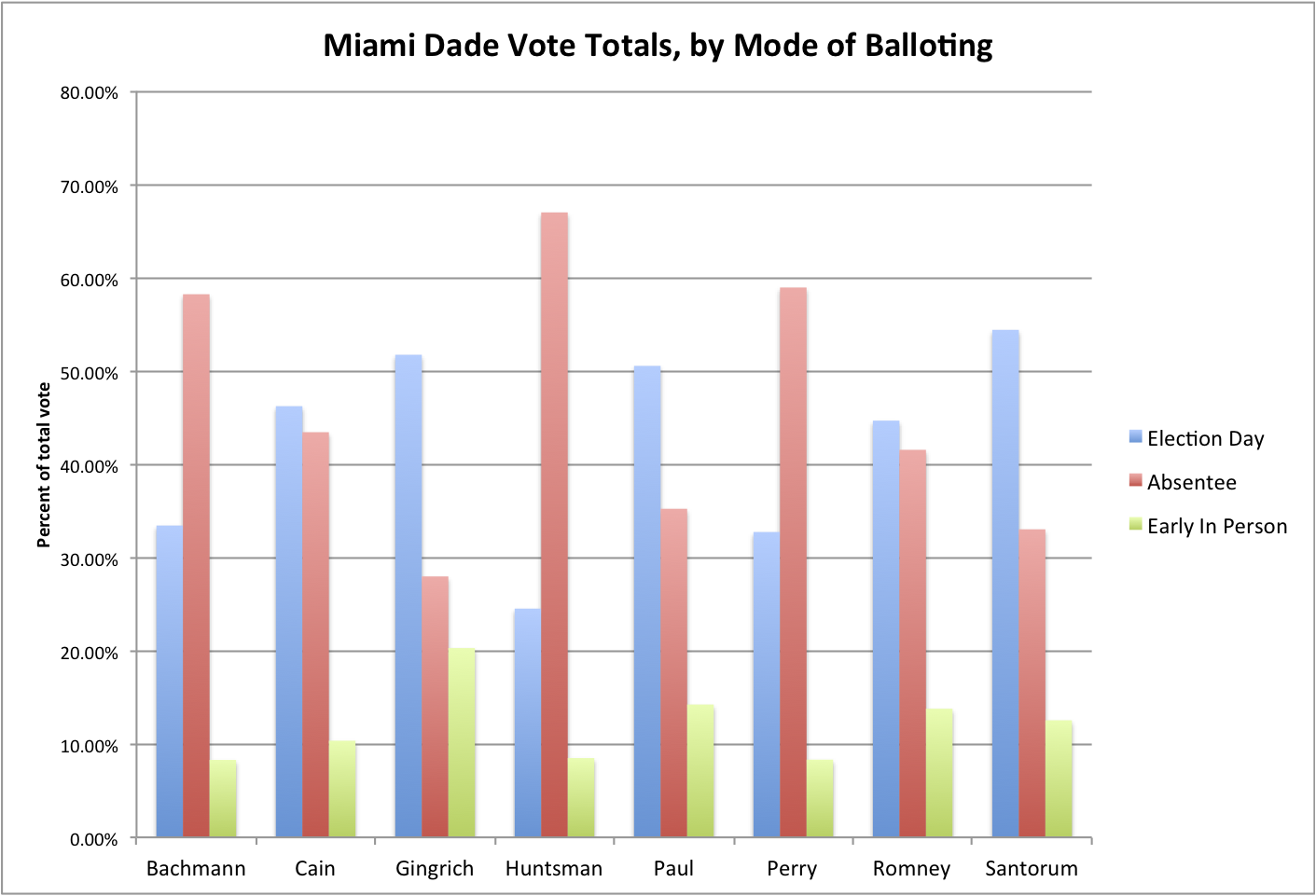
More voting by mode in FL: Still the odd Cain result
Another county’s results are plotted below, and while it’s too soon to assume a lot from just two counties, there is still a lot of election day votes cast for Cain, as a proportion of his total. Perry, Bachmann, and Huntsman look more like I’d have expected.