Early Voting Trends: Surge or Return to Normal?

Charles Stewart III, MIT

[Note: This posting was written on the eve of Election Day, based on statistics reported Monday morning.]

We’ve come to the end of the time in the election cycle when the politically engaged, tired of obsessively going to FiveThirtyEight or the Silver Bulletin, look to other tea leaves. A few of you may still wonder what the mail and early in-person voting trends portend for the results tonight. Here are some thoughts on that.

(Before proceeding, a little nomenclature: Some people—journalists, election officials, and just normal folks—mean different things when they say “early voting.” When some refer to early voting, they mean any votes cast before Election Day, whether cast in person or at home. Others only mean votes cast in person. To try to avoid that confusion here, I will refer to the in-person version as “early voting,” and combined early in-person and by-mail voting as “advance voting.” I will refer to ballots cast after being mailed to a voter as “by-mail ballots.” )

My simple answer to the “what does this all mean” question is that things seem to be returning to normal in two related ways. First, voters are mostly returning to pre-pandemic voting patterns (with important exceptions). Second, campaigns are recognizing they need all the turnout weapons in their arsenal to win.

2024 represents the return to a long-term trend of increased advance voting

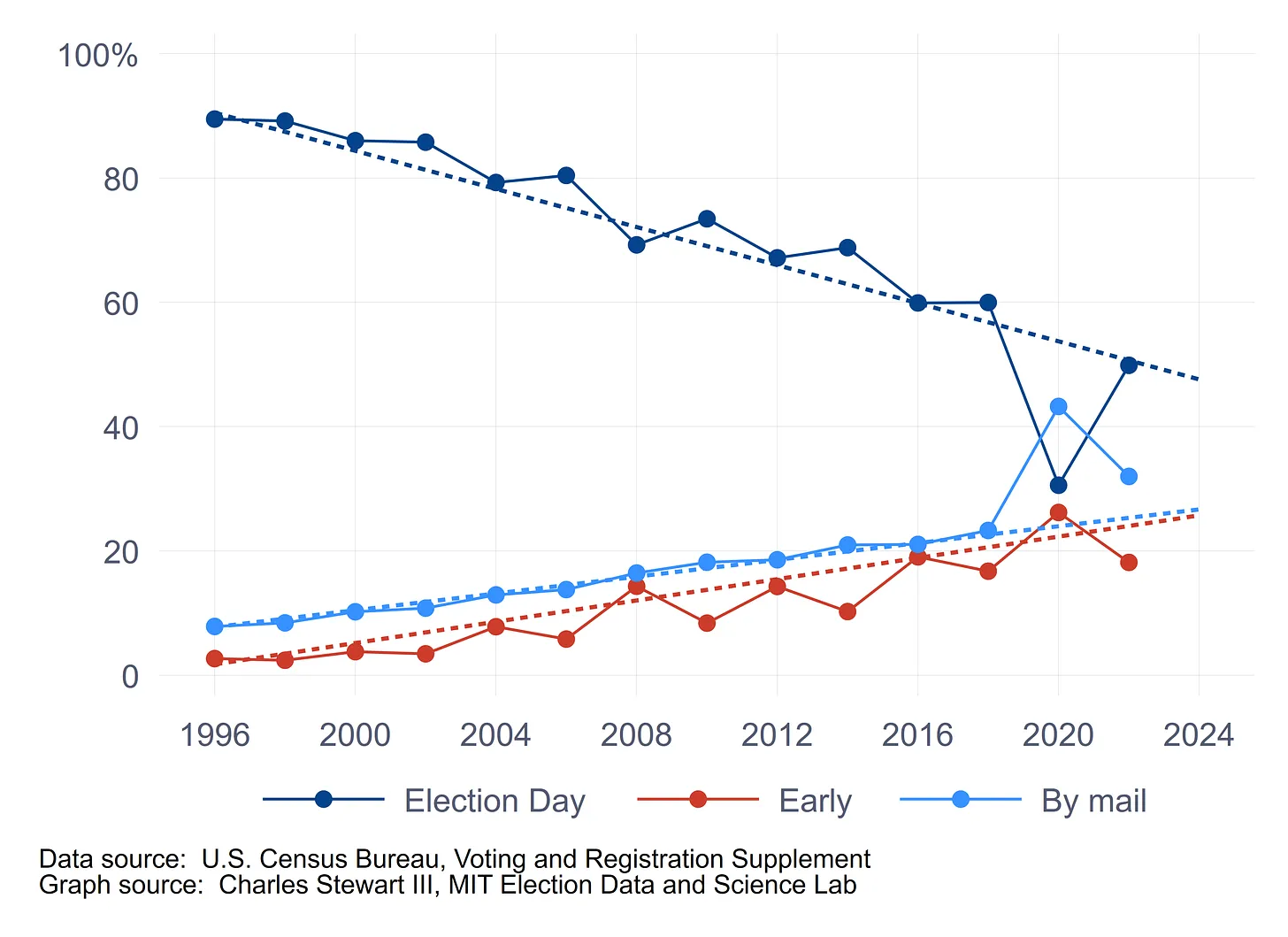
First, the patterns of the use of vote modes. As illustrated in the graph below, prior to 2020, the fraction of people voting on Election Day had been declining linearly for a quarter century, replaced in equal measure by people voting by mail and voting early. This pattern was interrupted by the pandemic, which shifted large numbers of voters out of Election Day voting booths into other modes, especially voting by mail. In 2022, mode usage either returned to the pre-pandemic trend or at least was much closer to the trend. (By-mail voting was about 5 points above trend in 2022, while early voting would have been right on trend if we account for the obvious seesaw pattern in the data between on- and off-year elections.)
Vote Mode in Federal Elections, 1996-2024

The dashed lines in this graph are based on simple linear trends in the use of the three voting modes from 1996 to 2018, estimated using linear regression. Although the trends are based on the data from 1996 to 2018, they have been extended to 2024 to see how the pandemic and the recovery from it affected the long-term trends.

Not surprisingly, in 2020, Election Day voting was significantly below trend, while by-mail voting significantly exceeded it. Early voting was roughly what we would have expected without the pandemic. In 2022, Election Day voting returned us to where the long-term trend predicted; early voting was slightly below the trend, and mail voting slightly exceeded it.

The ends of the trend lines provide the predictions of mode usage in 2024 if we just allow the pre-pandemic trends to continue. This is obviously a mindless prediction, if you want to call out-of-sample prediction using regression mindless, but it does help define the expectations ballpark for this year.

Keep in mind that most states made changes to their laws that either facilitated or reined in advance voting before 2022, so state-law-induced factors weighing on 2024 are already baked into the trends for the most part. The decision by Republican strategists to validate advance voting in 2024 may have played a role in the growth of voting in the pre-Election Day period this year. Still, the shift could also have reflected voters deciding how they prefer to vote, given what’s going on in their lives.

As voters shift to early voting in 2024, they are also shifting away from by-mail voting, compared to 2020. Based on Michael McDonald’s indispensable early voting website and some back-of-the-envelop calculations of my own, it appears we are on target for over 40 million early votes in 2024, up from 36 million in 2020, and 48 million by-mail votes, down from 66 million in 2024. Both of these numbers are right where the trend lines in the above graph would predict if turnout ends up at around 160 million. This also means that 2024 may be the second election in a row in which most votes are cast before Election Day. (It will at least be close.)

The closing partisan gap

Of some note, in 2024, there has been a shift in thinking among Republicans about the value of voting by mail. Certainly, the GOP and its candidates are giving mixed signals about advance voting. Still, just as Donald Trump’s attack on by-mail voting helped create a partisan chasm in voting by mail in 2020, his campaign’s change of attitude in 2024 has to make a difference, too.

For the decade before 2020, Democrats were only slightly more likely to vote by mail than Republicans, and almost all that difference was accounted for by the greater availability of no-excuse absentee voting and universal vote-by-mail in predominantly Democratic states. As the graph below shows, in 2020, a gap of nearly 30 points opened up between Democrats and Republicans in usage rates of by-mail ballots. That gap was then cut down to 12 points in the 2022 midterm.

Partisan Gap in Vote Mode

It appears that the gap has been diminished even further in 2024, although we cannot be 100% certain about how much. The party statistics reported by the states and communicated by Michael McDonald reflect the party registration of those returning ballots in states that record party registration. We won’t know for sure about the size of the partisan gap until surveys that track such things begin to report their results.

An increase in Republican by-mail voting in 2024 could just represent the demise of the stigma associated with mail voting. A decline in the use of by-mail voting by Democrats could also just represent a weakening of the sense that voting by mail is part of one’s Democratic duty.

Of course, it could be that a decline in advance voting by Democrats in comparison to Republicans could reflect a better mobilization effort by the Trump campaign and a lagging effort by Republicans. I’m doubting it, though. If I were a betting person, my money would be on voters and campaigns getting closer to a pre-pandemic normal. By Tuesday night, we’ll see if I’m right.
Blue Shift, Red Shift?

Charles Stewart III, MIT

The 2020 election taught America what most political pros already knew: votes aren’t counted immediately, and there are partisan patterns in how election results unfold. America also learned new terms for these partisan patterns: the blue shift (if you’re academically oriented) and the red mirage (if you read Axios).

As Election Day approaches, it’s time to dust off what we learned about the blue shift/red mirage in 2020 and apply it to 2024.

Vote share trends in 2020

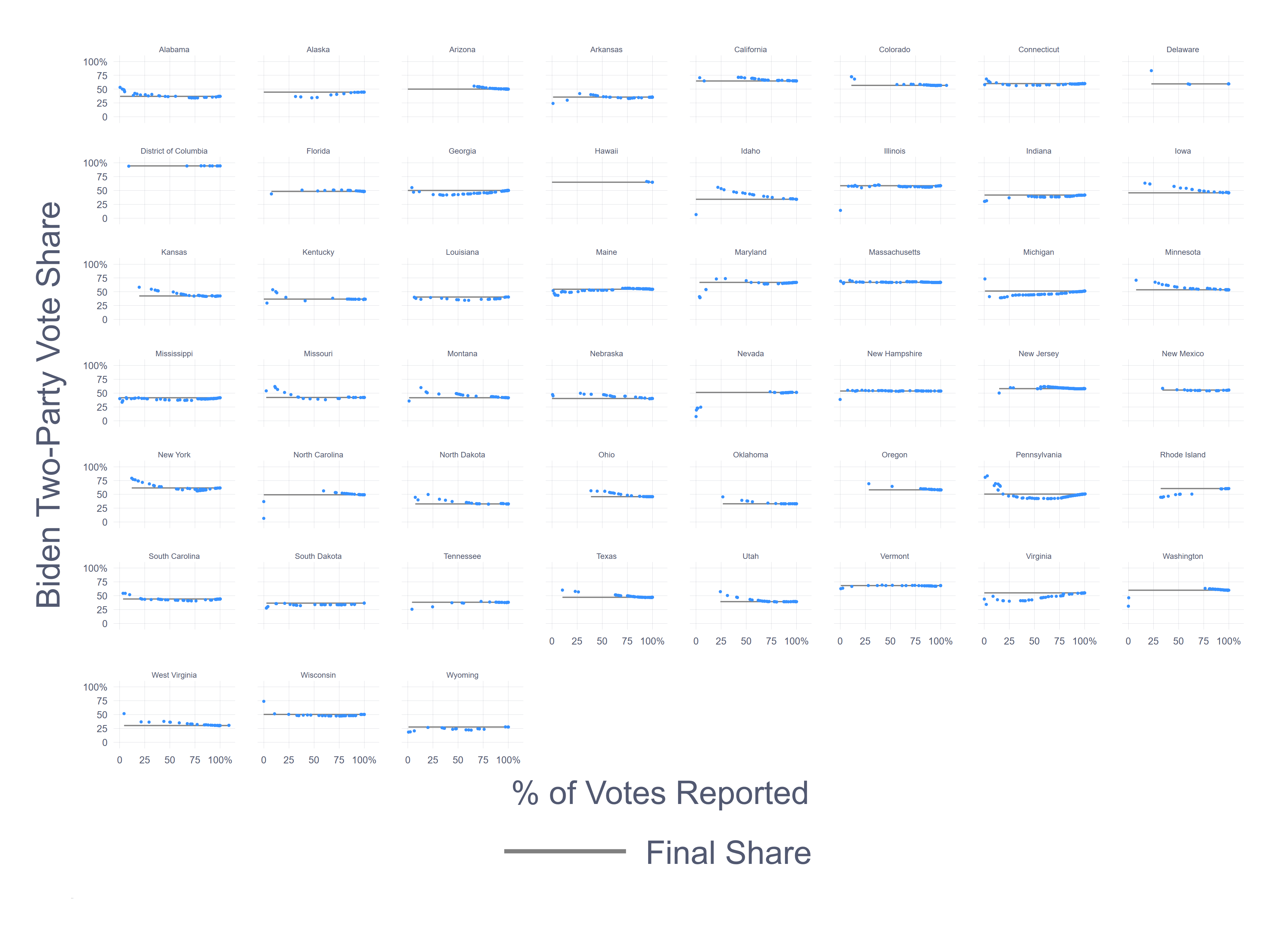
To jump to the chase, the following two graphs summarize partisan patterns to the reported vote in each state in 2020. Let’s start there.

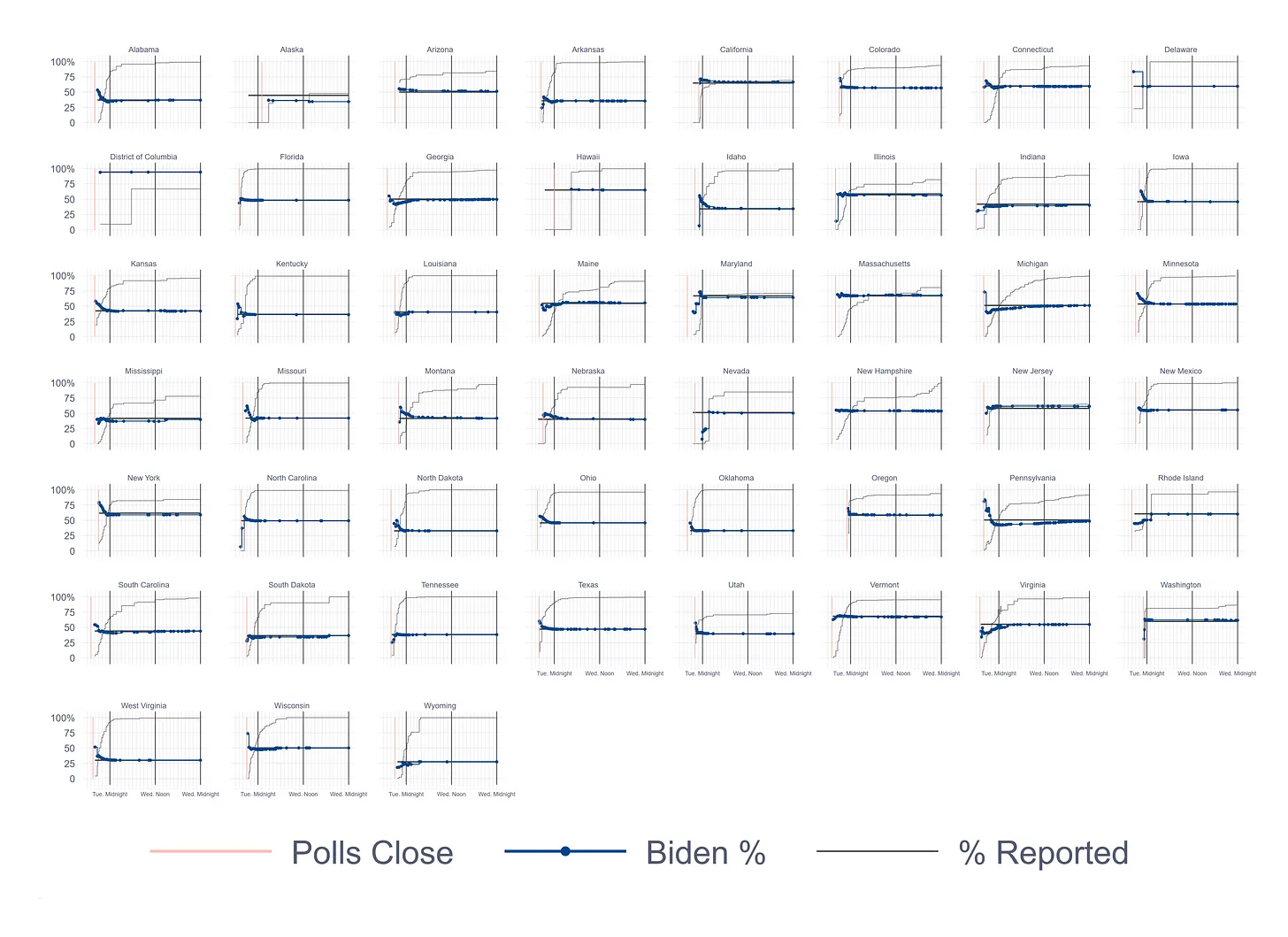
The first graph shows Biden’s two-party vote share from the close of polls in every state through midnight on Wednesday following Election Day. (The subgraphs are admittedly tiny, so click on this link and zoom in if you’d like to take a closer look.) The blue circles show each vote report during this period. The gray line shows the percentage of the vote reported and when it was reported.

Two-party vote share for Biden from the closing of polls until midnight Wednesday following Election Day.

For an election data nerd like me, I can spend hours studying this graph, but a couple of things stand out. First, although the phenomenon is called the blue shift, suggesting a steady evolution of vote share from a Trump majority to a Biden majority, in fact, for many states, the pattern was nonlinear. Take Georgia, for example. The very first vote report, with 4% of the eventual vote reported, showed Biden with 55% of the two-party vote. However, his share quickly dropped until it bottomed out at 42% just an hour and a half later. At that point, Biden’s share of the reported vote started a slow and steady rise. (He did not overtake Trump until Thursday, which is not on these charts.) Pennsylvania showed a similar pattern that was even more exaggerated.

Second, most states actually saw a red shift during this period. Setting aside the earliest vote reports (which I define as all reports before 10% of all ballots were reported), only 13 states saw Biden’s vote share grow during this time.

A broader view of the vote share shifts can be shown if we plot the two-party vote share for Biden against the percentage of all votes reported in a state. Those plots are shown in the next graph. (Click here if you want a bigger graph you can zoom in on.)

Plots of the Biden two-party vote share against the percentage of votes reported show that in most states, there wasn’t a steady blue shift in 2020.

This graph perhaps provides a clearer view of the two patterns I discussed above when I confined myself to the first day and a half after the polls closed. Most states—31—saw Biden’s reported vote share start above his final vote in the state before dipping below his final share. Georgia and Pennsylvania again provide good examples of this.

These graphs help make the point that vote reports did not all follow the same path in 2020. They also show that the idea of the blue shift is more complicated than often understood. What most people are thinking of when they say that Georgia and Pennsylvania had blue shifts is what they experienced toward the end of the vote-counting period, when the nation was on tenterhooks about the outcome of the election. And what they fail to appreciate is that many states, in addition to Arizona, also had pronounced red shifts late into the count.

Some thoughts for 2024

These are the patterns from 2020. What do they tell us for 2024?

For most states, we can probably expect similar patterns. The patterns observed in the graphs above reflect the results of an interaction of state election laws, local practices, and unique urban/rural differences. Most of these things haven’t changed much in most states.

However, they have changed in some states. For instance, Georgia now requires its counties to report its early in-person and mail votes within an hour of polls closing. This could easily put 75% to 80% of all the state’s votes out at once, leaving little room for any movement afterward. It will also reduce, but not eliminate, the pattern of rural counties reporting first and urban counties coming in later. Similarly, Michigan’s allowing for pre-processing of mail ballots should dampen any blue or red shift and shorten the period over which it occurs.

Finally, reports of early in-person and mail voting suggest that Republicans are more active in turning out before Election Day than in 2020. In those states where the blue/red shift is caused by differentials in how the two parties’ supporters use different voting modes, differences in vote reports over time will be muted.

Looking back to 2020 for a Guide to How Fast the Votes Will Be Reported in 2024

Charles Stewart, MIT

As we approach Election Day, I’ve been getting lots of questions about what to expect as the election results are reported. Will we be seeing the same patterns as in 2020? Will Pennsylvania take forever to count its votes because of limitations prohibitions on pre-processing? Will Arizona slow-walk from a comfortable Democratic lead to a nail-biter?

The simple answer to all these questions is that we’re likely to see similar patterns to 2020 and 2022, although some states will be more similar than others. The reason for the similarities is simple: for many states, the rules governing the counting and reporting of votes will be quite similar to 2020.

I can hear you saying, “Wait a minute. Didn’t 2020 see a surge of voting by mail that won’t repeat in 2024? Surely, that will affect what the vote reports look like.” In some states, that will be undoubtedly true. However, for most states, the laws in 2020 that sped up the counting of mail ballots, notably allowing for mail ballot pre-processing, will remain in place. To the degree that mail ballots may slow down the count, the presence of fewer mail ballots in 2024 may speed things up a bit. In addition, in many states, the mail ballots are the first to be reported, not the last, because they’re available to be tallied centrally either during Election Day or as soon as the polls close.

The pace of counting in 2020

In 2020, the team at the MIT Election Data and Science Lab (MEDSL) scraped the election results reported by the New York Times, which, in turn, were provided by Edison Research. This gives us a picture of how quickly states reported results in 2020 as a baseline for what to expect in 2024.

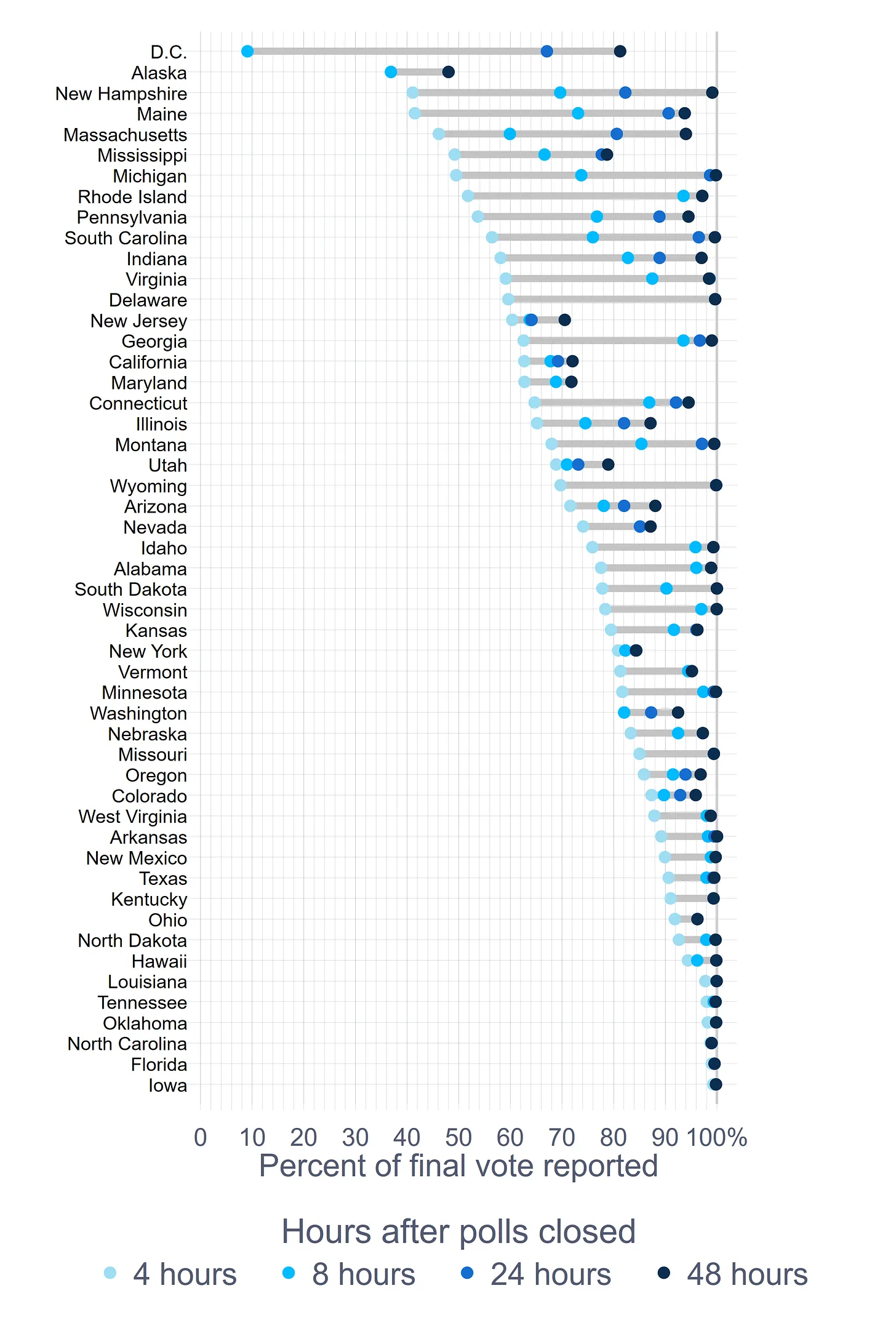
Also in 2020, MEDSL published a report that analyzed these data. One of the analyses we performed was on the velocity of vote reporting, measured in several ways. One simple way to illustrate cross-state differences was to show the percentage of votes reported 4, 8, 24, and 48 hours after polls closed in the state. A figure showing those numbers appears below, with the fastest-reporting state after four hours (Iowa) at the bottom and the slowest state (D.C.—I’ll call it a state for these purposes) at the top.

This figure helps to illustrate the frustration many voters and politicians felt on election night and beyond. While some states could get almost all their votes reported by the wee hours of Wednesday morning, only about half had reported 90% of their votes eight hours after polls closed. Among the seven battleground states this year, North Carolina was, by far, the fastest out of the shoot, trailed a long distance by Wisconsin, which was about in the middle of the pack. Michigan and Pennsylvania were among the ten slowest.

I invite the reader to study this figure (or look at the report) because it reveals all sorts of nuances about how states report their vote totals. Georgia, for instance, was a relatively slow-reporting state after four hours but quickly caught up after midnight of election night. After 48 hours, it was in the top half of states in terms of votes reported. On the other hand, Alaska reported about half its votes by Wednesday morning and then stopped for several days owing to the challenges in aggregating vote totals in that far-flung and road-poor state.

The role of pre-processing

One detail about vote reporting not evidenced in this figure is what the pre-processing of mail ballots does to the speed of voting counting. In the statistical analysis performed in the MEDSL report, the failure to pre-process did slow down the count, on average, but by a small amount. Within four hours of the polls closing, the average state with no pre-processing had reported 63% of its votes, compared to 78% that didn’t restrict pre-processing. At the twenty-four-hour point, the gap between states had essentially disappeared.

In a later academic paper written by me and two MEDSL colleagues, we also found that states with more mail ballots reported at a slower pace. However, the effect of mail-ballot load also declined over time.

Three thoughts for 2024

What does all this mean for 2024? I would highlight three things.

First, pre-processing make a difference, although it makes the biggest difference in the early hours of counting. In 2020, seventeen states prohibited processing of mail ballots before Election Day. In 2024, that number declined to seven. Unfortunately, three are battleground states: New Hampshire, Pennsylvania, and Wisconsin. (Michigan will allow pre-processing in 2024.)

Second, there will be fewer mail ballots in 2024 than in 2020 to be processed on Election Day in these states. At this point before Election Day in 2020, nearly 3 million mail ballots had been sent out in Pennsylvania; as of today, just over 2 million have been sent out for 2024. In Wisconsin, nearly 1.5 million mail ballots had been issued a week before the 2020 election; this year, the number is about 600,000. Thus, even though there will be a lot of mail ballots to process on Election Day, that number will be significantly less than in 2020.

Third, perceptions of vote-reporting speed in 2020 were heavily influenced by the closeness of the count. Georgia, for instance, got a reputation as a slow-counting state even though it was in the middle of the pack after midnight of election night. The long wait until Thursday for Georgia to be “called” for Biden wasn’t because Georgia was slow, but because of a small number of ballots—such as straggling UOCAVA ballots, provisional ballots, and damaged ballots—that needed to be processed before the count was all finished.

There are other things to say about the speed of vote reporting, especially about reporting in non-battleground states, but I will leave that for another time.

One last thing

I will end with this, however. It is important to remember that the reports of votes on election night are just that, reports. Once the initial unofficial reports are issued, localities and states begin the canvass, which confirms the results, resolves discrepancies, and moves toward official results. It is important to get the results reported quickly, but it is even more important for them to be accurate. In the days following the election, I hope the public will watch the canvassing process carefully, but also give election officials the room they need to make sure the results are correct.

Election Science and the 2022 U.S. Elections

Believe it or not, we are well into the 2022 U.S. midterm elections. Our research group is still working on various research products using the vast amount of data that we collected in 2020, and I’ll be writing more about those research projects here in the near future.

It’s now spring quarter at Caltech, when I traditionally teach our introduction to elections and campaigns class, Political Science 120. The past few weeks, as I’ve been going back over a lot of research on election administration and technology, teaching it to the students in the class, I’ve also been reflecting quite a bit on the state of election science and the advances that have been made in the past two decades.

I recently took a few old Votomatic punchcard devices to class, to show the students, and when I pulled them off the shelf where they had been stored, look what fell out!

These chads brought back to life what things were like in the immediate aftermath of the 2000 presidential election, in those days when there was little academic research on election technology and administration. When the Caltech/MIT Voting Technology Project (VTP) was getting started in the fall of 2000, we were surprised to learn that we lacked basic measures, like how to measure the reliability of voting technologies (which of course led to the invention of the residual vote measure, which is a story to tell later).

As I was recounting in class a brief version of the history of the VTP, I realized two things. First, it’s remarkable the amount of research that the VTP has produced. There are quite a few working papers available on the VTP website, and many others that have been posted in other working paper and preprint archives. Much of this research has been published in peer reviewed journals, and VTP researchers have also produced a number of books in the past two decades. Second, it’s also remarkable to see the dramatic growth and diversification in the academic study of election administration and technology. While back in 2000 I think that there were just a few dozen scholars with experience in the field, that number has exploded in recent years. It’s common today to see election science research being presented and discussed at major academic conferences, and there’s now an annual conference devoted to the field (the Election Sciences, Reform, and Administration annual conference, to be held at the University of North Carolina, Charlotte — July 27-29, 2022). Election science research is also ever more common in the journals today, with new generations of scholars helping to build a strong foundation of published work that continues to advance knowledge in the field.

The challenge is going to be working to document these trends this year, in addition to writing more here about the work that our research group and the VTP are conducting, I’ll continue to try to connect to the other research that is being done in the field, providing context for what other scholars are working on as we get further and further into the 2022 election cycle.

And before I go, one last thing — it’s great to report that the Caltech/MIT Voting Technology Project is alive and well, twenty-two years after it was founded by the Presidents of Caltech and MIT in the fall of 2000!

Accelerating Election Science

It’s really exciting to write that our report to the National Science Foundation’s Convergence Accelerator (NSF-CA) program, “Election Science: A Proposed NSF Convergence Accelerator” is now available. In this report, we argue that there are fourteen research challenges present critical opportunities for NSF-CA funding.

This report was produced with support from the NSF-CA, and my co-authors (or in NSF lingo, co-Principal Investigators, or “PIs”) on the project are Moon Duchin (Tufts University), Gretchen Macht (University of Rhode Island) and Charles Stewart III (MIT). It was a fun and productive experience working with Moon, Gretchen and Charles.

The project started with a number of brainstorming meetings among the co-PIs, and we thought long and hard about what we each identified as the important research opportunities in election science, challenges that were would require collaborations between technology providers, election officials, and academics — and challenges that if appropriately funded, might be solved within a few years.

We started with a first virtual workshop, which had an innovative format. The co-PIs invited a number of election officials from across the United States, representing different types of election jurisdictions, to sit down with one of us and discuss the pain points that they have experienced in recent election cycles, especially during the 2020 election. We also discussed with them the research priorities that the co-PIs had identified and got their input and feedback on those. We recorded these conversations, which was a unique experience, as it’s rare for academics like us to have the chance to sit with some of the most innovative election officials in the world and have an extended conversation about their experiences and what they think academics can do to help improve American election administration and technology.

These recorded conversations, then, were made available to the participants in four virtual workshops held this spring. Workshop participants represented the diversity of experiences and opinions about election administration and election science: academics (both experts in election science and those new to the area), election officials, technology providers, government officials, and stakeholders.

These four workshops spanned four days and sixteen hours, involving intensive large group, small group, and even one-on-one conversations, as we tried to narrow down the set of research challenges and find areas where there was consensus among the workshop participants about the importance and viability of each potential research challenge. In the end, the co-PIs were able to narrow down the list to fourteen research challenges, each of which is both “convergent” (in the sense that they require active collaboration between academics, and both the private and public sectors) and “ripe for acceleration” (in the sense that with appropriate funding solutions could be build in a short period of time.

The fourteen challenges are:

  1. Evaluating Tools for Election Administration
  2. Ensuring Usability within the Voting Experience
  3. Improving Access to Voting
  4. Communicating Effectively with the Electorate
  5. Detecting Anomalies in Election Management Systems
  6. Sharing Election Results for Research, Dissemination, and Anomaly Detection
  7. Visualizing Election Data
  8. Enhancing Voter Identity Verification
  9. Securing Electronic Ballot Delivery & Return
  10. Implementing End-to-End Verifiability
  11. Improving Cybersecurity for Election Administration
  12. Managing Election Geography
  13. Promoting Sustainable and Scalable Sharing of Election Technology
  14. Developing Next-Generation Voting Technologies

I encourage you to take a closer look at the report to learn more about why we identified each as an important research challenge.

So what happens next? Our report is now being reviewed by the NSF-CA, along with the reports from a number of other NSF-CA initiatives that they supported in this year’s cycle of studies. We hope that the NSF-CA decides that supporting these research challenges in the near future is an important priority, and if they do, that our initiative will move to the next stage of development at the NSF-CA.

I want to again thank the many busy people who took time this spring to work with us to help develop this agenda for accelerating research on election science. We learned a great deal from our workshop participants, and while we were forced to meet virtually because of the pandemic, we put the technology to good used and were able to meet new and get to know people passionate about advancing election science. Finally, I want to thank my co-PIs for a great opportunity to work with them, I learned a great deal about aspects of election administration and technology because of our collaboration.

Why Do “Blue Shifts” Happen in American Elections?

Yimeng Li, Michelle Hyun, and I just posted a revised version of our paper, “Why Do Election Results Change After Election Day? The “Blue Shift” in California Elections”. In the paper, we focus our attention on data from Orange County, CA, part of our ongoing research on election integrity in California. Orange County is a very good case for research, as we have a wealth of amazing data from OC, we’ve learned a great deal about how elections are run in OC, and of course, because the Orange County Registrar of Voters, Neal Kelley, has been wonderful about working with our research group.

Research like this would not be possible without strong partnerships with election officials like Neal Kelley. They are also difficult without a strong research group, and in this case, I’ve enjoyed working on this project with Yimeng and Michelle. Yimeng Li is a graduate student at Caltech, who has worked on a number of election science research projects. Michelle is an undergraduate at Caltech, who started working with us on this project as part of her Summer Undergraduate Research Fellowship (SURF) in 2019. As I’ve said many times in many forums, one of the truly remarkable aspects of being a prof at Caltech is working with our exceptional students!

The abstract of our paper summarizes our work and results well:

The counting of votes in contemporary American elections is usually not completed on Election Night. There has been an increasing tendency for vote shares to shift toward Democratic candidates after Election Day in general elections. In this paper, we study this phenomenon using granular data from Orange County, California. Leveraging snapshots of precinct-level election returns and precinct-level demographic and political composition, we conduct the first full-fledged analysis of the potential drivers of vote share shifts. Utilizing snapshots of individual-level administrative records, we provide the first analysis of the characteristics of voters whose ballots were tallied later versus earlier. Far from being anomalous, the vote share shifts are consistent with underlying precinct voter compositions and the order of individual ballot processing. We find the same underlying drivers in North Carolina and Colorado and discuss the implications of the evolving election administration practices across states for public concerns about election integrity.

Of course, in the paper we also present data from other states to help document the general nature of post-election shifts in vote tabulations in the U.S. They are common, and should not be surprising, because election officials are not processing ballots in random order. Rather, they process ballots in batches as they enter into the tabulation and canvass process, which in a jurisdiction like Orange County means that large batches of by-mail ballots may be processed in groups, while ballots from drop boxes and vote centers are likely to get processed in other batches. Provisional and last-minute ballots then may get processed in their own batches as well. As different types of voters are likely to be casting each type of ballot (by-mail early or late, voting in person, drop box voters, and provisional voters), that implies that we ought to see post-election tabulation results shift from party-to-party, especially in very close elections.

We’ve got more research planned on this topic, and of course, we continue to do lots of research with all of the important data we have collected from Orange County.

Another Gubernatorial Recall Election in California

Yes, it’s happening again.

California is very likely to conduct another gubernatorial recall election, most likely sometime in the late summer or early fall. As of media reports yesterday, sufficient signatures have been collected and submitted by those backing the current recall petition to put the recall of Governor Newsom on the ballot later this year.

While there is still some chance that the recall election may not happen (for example, if there is some legal or other administrative intervention, though the chances at this point of that occurring seem unlikely), there are a lot of unknowns still about how his recall election would be held.

For example, as election officials would need to start planning quite soon for this highly-likely recall election, would we see a repeat of statewide universal voting-by-mail for a 2021 recall election? While the pandemic seems to be receding currently in California, as other states are seeing surges in COVID-19 cases, there’s always a chance that California might see a surge.

And once the recall election date is set, and candidates start to file, how many people will file to be on the replacement ballot? Dozens of candidates? Hundreds of candidates? It’s impossible to know today how long the replacement ballot would be, but I’d not bet against there being a very long ballot of replacement candidates on a 2021 recall election ballot.

In any case, it seems like this recall election will happen. There was some excellent research conducted about the 2003 gubernatorial recall election, and now is a great time to dust those papers off and re-read them. I’ll start to post some thoughts about what we learned from that research soon.

I will make one prediction. The 2021 recall election, assuming it happens, will be a lot more tumultuous than pundits today are suggesting. There is likely to be a significant amount of litigation regarding the potential gubernatorial recall election, there will likely be a long ballot of replacement candidates, and the pandemic is likely to introduce complexity into the administration of a recall election.

Voter Confidence and Perceptions of Election Fraud in the 2020 Presidential Election

Our Monitoring the Election project has released two briefs, reporting on preliminary results from a national survey of registered voters conducted immediately after the November 3, 2020 Presidential Election.

These two briefs provide a glimpse into how the heated rhetoric about election and voter fraud before and during the general election has been received by the American electorate.

One of these briefs focuses on the general question of voter confidence in the election.

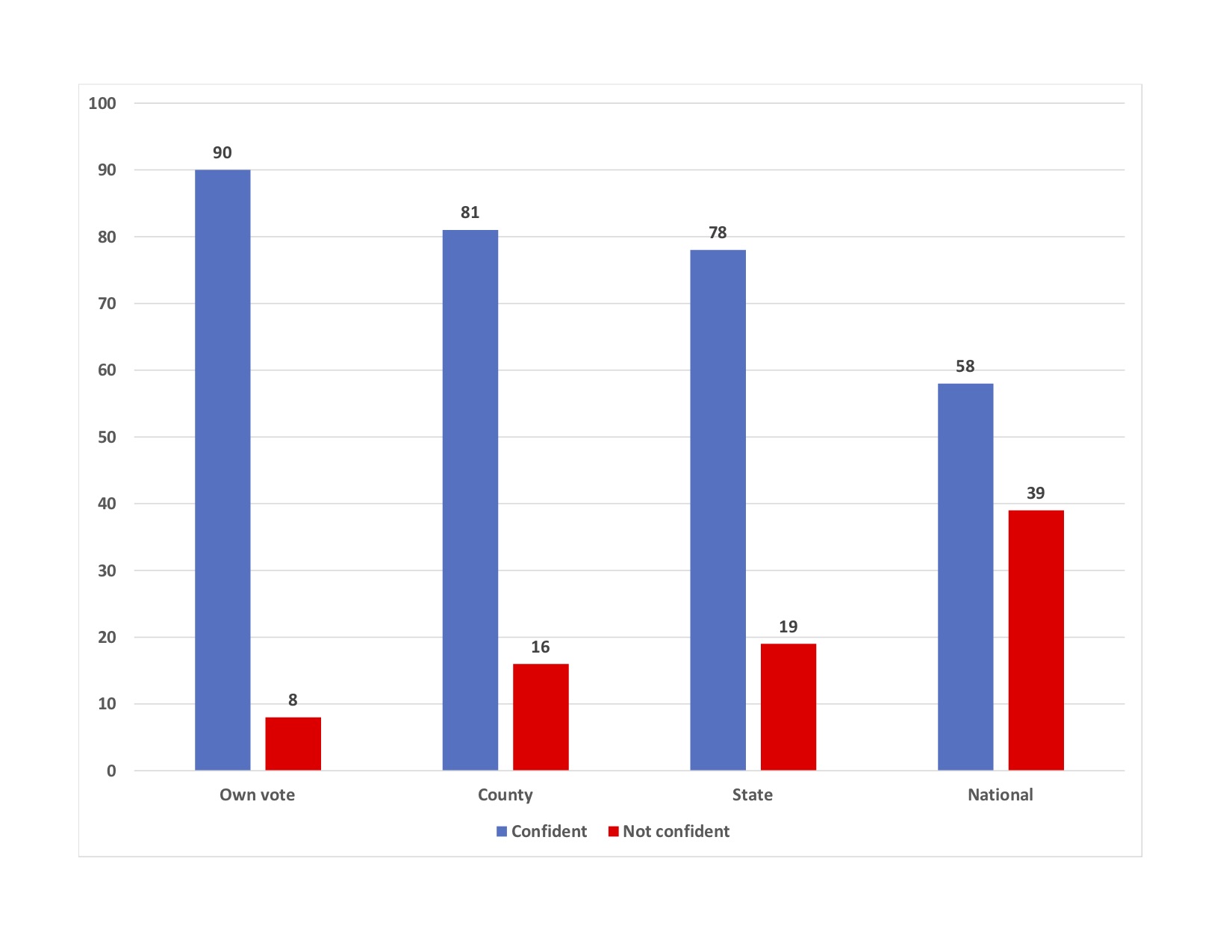
We asked registered voters to answer four questions about their confidence regarding the 2020 presidential election: their confidence that their own ballot was counted as intended (asked to registered voters who cast a ballot), and their confidence that ballots were counted in their county, their state, and across the nation (the latter three asked to all registered voters). The topline results are shown in this graph from the report.

Voter Confidence

As you can see, 90% of voters were confident that their ballot was counted as they intended, which given the heated rhetoric about this election is a remarkable number. It’s also remarkable that about eight of ten registered voters have confidence that votes were counted as intended in their counties and their states. Those are also remarkable numbers, and in my opinion, a strong indication that American voters are overall quite confident that their local and state election administration was handled well in this contested election.

But when we get to the national level, we find that just over a majority of American registered voters (58%) were confident about the administration of this fall’s election, and that 39% lacked confidence (the remaining registered voters didn’t have an opinion). This lower level of confidence about the national administration of the election is concerning.

Digging one layer deeper into the data, we looked at perceptions of confidence by partisanship and presidential vote. We see high levels of confidences for both Republicans and Democrats, and for both those who voted for Trump or Biden. Nearly every Democratic voters (and nearly every Biden voter) in our sample was confidence that their own ballot was counted as intended: 86% of Democrats were confidence, and 97% of Biden voters were confident. Among Republicans confidence in their own vote was high, with 85% of Republicans and 84% of Trump voters confident in their own vote being counted.

But moving to the national level, the sharp degree of partisan polarization in the United States emerges: while many Democratic and Biden voters were confident about the administration of the election nationally (84% among Democrats, and 87% among Biden voters), most Republicans and Trump supporters lacked confidence in the national administration of the election, with 66% of Republican registered voters lacking confidence, and 70% of Trump voters lacking confidence in the national administration of the vote.

The other brief, authored by Yimeng Li, focuses on a number of questions in the survey asking registered voters about their perceptions that various types of election or voter fraud might occur, and also about hacking of the voting technology in the 2020 election. The survey included questions asking whether the respondent thought that various types of election or voter fraud were common or not:

  • Double voting.
  • Stealing or tampering with voted ballots.
  • Voter impersonation.
  • Non-citizen voting.
  • People voting absentee ballots of other voters.
  • Officials changing reported vote counts in a way that is not a true reflection of how the ballots were actually counted.

Yimeng found that there is a sizable proportion of the American electorate that believes that voter or election frauds like these occur or are common. To quote from the report:

There are many registered voters nationally who said that election or voter fraud
is very common (between 12% and 17% for different types of fraud) or occurs
occasionally (15-17%). Ballot stealing or tempering, fraudulent casting of absentee
ballots intended for another person, and non-citizen voting are perceived to be the
top three types of election or voter fraud. Only about half of the voters believe each
of the six types of fraud occurs infrequently or almost never.

Like we saw regarding voter confidence in the 2020 Presidential election, the perceptions of the American electorate are very polarized along partisan lines. Across the six different types of election or voter fraud we asked about in the survey (Table 2 of the brief), we generally see that majorities of Biden voters believe that these types of fraud are infrequent or that they never occur, while majorities of Trump voters believe that these types of fraud are very common or that they occur occasionally.

A good example of this regards non-citizen voting. Sixty-six percent of Biden voters said that non-citizen voting almost never occurs, while another 12% said it occurs infrequently. On the other hand, 35% of Trump voters said that non-citizen voting is very common, and another 25% said that it occurs occasionally. That’s a pretty stark partisan different in perceptions of the incidence of non-citizen votes.

So what does this all mean, in particular for future elections in the United States?

It seems clear from these topline estimates from this survey that the American electorate remains confident that their own votes were counted, and that they are quite confident that votes in their counties and states were counted as intended. Which is a good sign.

But we see much less confidence in the national administration of the election, where opinions are deeply divided on party lines. We also see that a reasonably large segment of the electorate believes that various types of election or voter fraud occur, and that perceptions about the incidence of election fraud are polarized by partisanship.

This indicates that voters are picking up on elite partisan rhetoric about election and voter fraud, which have been going on since 2016, and which of course has intensified in the past few weeks. But does this mean that despite high levels of voter participation in the 2020 presidential election, will those who lack confidence or are concerned with fraud might be less likely to vote in future federal elections (for example, the 2022 and 2024 elections)? Will the lower levels of confidence in the national administration of federal elections, and concerns about election fraud for some segments of the electorate, lead to further erosion of trust in American democratic institutions?

At this point it’s hard to know what might happen. But these survey results provide some cause for concern, and they show that we need to continue our work to inform the American electorate about the integrity of the 2020 presidential election.

We’ll be posting additional briefs from our survey in coming days and weeks on our website.

Election Day Update From California

It’s a beautiful Election Day, at least here in Southern California!

A few quick morning updates.

  • The California Secretary of State’s latest updates (as of 11/1/2020) notes that 11,161,493 vote-by-mail ballots have been returned (with 22,388,716 issued). They are reporting (as of 11/1/2020) 661,265 in-person votes cast. That’s a total of 11,822,758 ballots returned or cast. Note that the final totals on the number of votes cast in the 2016 presidential election statewide was 14,610,509. It’s quite likely that by the time all of the ballots are in that we’ll exceed the total number of ballots cast in the 2016 presidential election.
  • San Bernardino County (one of the Southern California counties we are tracking) is reporting 463,351 ballots returned as of 11/1/2020. At a similar point in the 2016 presidential election cycle (San Bernardino County reported 221,470 ballots returned). Note that the 2020 mail ballot return numbers in San Bernardino County are currently running about twice what they were in the 2016 presidential election.
  • Orange County (another of our Southern California counties we are monitoring) is now reporting 1,208,924 vote-by-mail ballots returned (of 2,024,785 issued). As of 11/02/2020 OC is reporting a total of 182,841 in-person votes cast, which if we add those to the vote-by-mail ballots returned is 1,391,765 ballots returned or cast in OC.
  • Los Angeles County (yes, we are monitoring LAC as well!) last night reported 146,558 in-person votes cast, and 2,651,717 vote-by-mail ballots returned. From the data we are seeing, turnout this morning at voting centers in LA County is strong, and no doubt, there are still ballots being returned by mail, at drop boxes, and at voting centers throughout the county.

You can see our monitoring reports at Monitoring the Election.

So what are we seeing? Obviously there’s a lot of interest in this election, and so far, California’s voters have responded by returning their vote-by-mail ballots, or by voting in-person. More later today as we get additional data, and after visiting a number of in-person voting centers today.

What’s Michigan to Expect with Early Voting?

Charles Stewart III

The Healthy Elections Project has been running a series of surveys in a half dozen battleground states, asking how voters intend to cast their ballots.  I have previously published thoughts on Arizona, Florida, North Carolina, Pennsylvania, and Wisconsin, with a bonus posting about Georgia (where we are not surveying, ourselves.)  This brief note focuses on Michigan.

First, about the intentions themselves.  The table below shows that there was very little movement in reported intentions across the four waves of the surveys.  An ANOVA test fails to reject the null hypothesis that the four waves are drawn from independent samples, so I proceed using results from the pooled survey, discarding the “don’t knows.”

Vote mode intention among likely voters, including don’t knows
Date

Election Day

Early Mail Don’t know

N

Sept. 4 – Sept. 11

44.0%

7.2% 45.1% 3.8%

484

Sept. 16 – Sept. 25

40.5%

4.3% 49.4% 5.9%

490

Sept. 30 – Oct. 9

37.2%

4.7% 55.6% 2.5%

484

Oct. 14 – Oct. 21

39.8%

10.5% 48.6% 1.0%

491

Total

40.4%

6.7% 49.7% 3.3%

1,949


Vote mode intention among likely voters, excluding don’t knows
Date

Election Day

Early Mail

N

Sept. 4 – Sept. 11

45.7%

7.5% 46.8%

465

Sept. 16 – Sept. 25

43.0%

4.5% 52.5%

462

Sept. 30 – Oct. 9

38.2%

4.8% 57.0%

472

Oct. 14 – Oct. 21

40.2%

10.7% 49.1%

486

Total

41.8%

6.9%

51.4%

1,885

(By the way, the overall 95% confidence interval for all four waves combined is around +/- 2.2 points.  For any one wave, it’s around 4.4 points.)

Second, to convert these expectations to raw numbers, we need an estimate of turnout. In most of the other memos, I used a couple of ad hoc methods.  Since then, I have come across the state-level turnout estimates that are produced as a byproduct of the FiveThirtyEight presidential election forecasting model, and so I’ll use those instead.  For Michigan, the low and high estimates are 4.8 million and 6.2 million, respectively, which is what I’ll use here.  However, turnout in 2016 was 4.9 million, and thus I’m certain that the low estimate is too low.

Third, here is what the combination of numbers above imply for the final distribution of votes in Michigan, by mode:

Vote mode, combining four waves of survey
Assumed turnout

Election Day

Early

Mail

4.8 million

2.712M

125k

1.963M

6.2 million

3.503M

161k

2.536M

Fourth, a final calculation needs to be made, if we want to estimate the number of mail ballots that will be requested, since not all mail ballots are returned.  For the states that make their absentee ballot files available, it appears that in 2016, around 85% of requested mail ballots were returned.  If that return rate holds for Michigan, then it should expect between 2.3 million and 3.0 million requests.

There is one data issue that needs to be brought up here.  Michigan does not have a full-bore early voting program.  Rather, it allows in-person absentee voting, but it does not keep track of this separately.  For that reason, and because so few survey respondents indicated they planned to vote in-person before Election Day, I will proceed by considering only mail balloting.

The other data issue is that Michigan, unlike most of the other battleground states, does not provide an easily accessible absentee file to the public, nor even a daily report about these statistics.  For that reason, I’m relying here on Michael McDonald’s irreplaceable reports on his U.S. Elections Project website for these statistics.

As of yesterday, the U.S. Elections Project reports that 3,109,105 ballots had been requested and 2,255,280 mail ballots had been returned.  The deadline for requesting mail ballots is this Friday, although the state (really, the world) has been encouraging voters to request their mail ballots as soon as possible.  Therefore, it seems highly unlikely that anything more than 3.2 million ballots will be requested.

On the returns side, the past week has seen about 66,000 ballots returned per day.  This should pick up in the final days leading up to Election Day.  Nonetheless, at this pace, and with the deadline for receipt on Election Day.  That would yield another 462,000 ballots, or 2.7 million, total.

The following graph summarizes the important calculations.

As for Election Day, this is where the turnout estimate really matters.  If we believe the low-end turnout projections of 4.8 million and that 2.7 million mail ballots returned, that leaves 2.1 million to vote on Election Day.  If the high-end projection of 6.2 is correct, then Michigan would be at 3.5 million on Election Day. If I had to choose, I’d go with the higher estimate.